
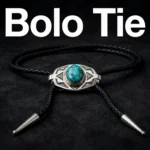







Bolo Tie: The Cowboy Necktie Born From a Lost Hatband
A bolo tie is not a tie in the usual sense. There is no knot, no wide blade of cloth, and nothing to tighten around the collar. It is a cord worn round the neck, held in place by a slide, with metal tips at the ends of the cord. It is the neckwear of the American West, and it became the official neckwear of Arizona — but the story of where it came from is disputed, and it has two sides, not one.
The most repeated story credits one man, an Arizona silversmith, with inventing it after a hatband slipped off on a windy ride. The older story says the form was already there, worn by Navajo, Zuni and Hopi men in the 1930s. Both stories are part of the record, and this article tells both.
What a Bolo Tie Is — Cord, Slide, Tips
A bolo tie has three parts, and each one does a job. The cord is the body of the piece: a braided leather cord that hangs round the neck in a loop. The slide is the centrepiece: a decorative piece of metal, stone or shell that the two ends of the cord pass through, sitting at the throat. The tips are the metal ends of the cord, finishing the two hanging ends.
The slide is what makes the bolo tie work. It holds the cord in place and sets how the piece sits: pushed up, it closes the loop at the throat like a tie knot; slid down, it opens the loop and lets the cord hang loose. It can be silver, turquoise or stone, and it is the part of the piece that carries the design.
The Hatband Story — Cedarstaff, Late 1940s, Patent 1959
The most repeated story of the bolo tie’s origin belongs to Victor Emanuel Cedarstaff, an Arizona silversmith from Wickenburg. His silver-trimmed hatband slipped off on a windy ride in the late 1940s, and rather than lose it he wore it round his neck, with the silver trim at his throat. He worked on the idea and patented the slide design in 1959, having filed the patent in 1954.
It is a good story, and it is the one most pages tell. A hatband becomes a necktie on a windy ride, and a silversmith turns an accident into a design. The patent gives the story a date — filed 1954, granted 1959 — and Cedarstaff said the name came from the Argentine boleadoras, the cords thrown by gauchos.
But a patent is not the same as an invention. It protects a design — in this case, Cedarstaff’s slide design — and it does not prove that no one had worn a cord with a slide before him. The story is true as far as it goes, and it is the story that made the piece famous. It is not, however, the whole story.
The Older Story — Navajo, Zuni and Hopi Silversmiths in the 1930s
The form of the bolo tie is older than Cedarstaff’s patent, and older than his windy ride. In the 1930s, Navajo, Zuni and Hopi men were already fastening their bandanas and neckerchiefs with a shell or silver slide, worn as everyday dress in the Southwest.
Native silversmiths shaped the look of the piece from the start. The silverwork, the stone settings and the sense of what a slide should be all came from their craft, and the piece as it is worn today carries that work in it. The turquoise and silver slides that people picture when they think of the piece are part of that tradition, not an addition to it.
This is why Cedarstaff cannot be presented as the sole inventor. He gave the piece a name, a patent and a famous story, and his part in its history is real. But the form itself was already being worn by Navajo, Zuni and Hopi men a decade or more before his hatband slipped.
Why Arizona Made It Official (1971)
Arizona named the bolo tie its official state neckwear in 1971. It is a small fact with a large meaning: a state does not give official status to a piece of clothing unless that clothing says something about the place. The bolo tie says Arizona — the desert, the silverwork, the ranching culture and the Native craft of the Southwest, all in one piece of neckwear.
The 1971 decision came after the piece had already spread beyond the Southwest and become a recognised part of Western dress. Arizona’s decision made that recognition official.
How to Wear One — And When Not To
A bolo tie is worn with the cord round the neck and the slide sitting at the throat. Pushed up, the slide closes the loop and the piece sits like a tie. Slid down, the loop opens and the piece hangs loose.
It suits Western dress and occasions where a knotted tie would be too formal or out of place. It goes with a Western shirt and a jacket, and it is at home where Western dress is the custom.
It does not suit every occasion. Where a knotted tie is required, it is the wrong choice, because it is not a knotted tie and it does not pretend to be one.
Bolo Tie vs Necktie — What Is Different
The difference between a bolo tie and a necktie is the difference between a cord and a knot. A necktie is a length of cloth tied in a knot at the collar, with a blade that hangs down the chest. A bolo tie is a cord held by a slide, with two hanging ends tipped in metal.
The difference is also in the wearing. A necktie is fixed once it is knotted; it can be adjusted all day by moving the slide. A necktie is formal dress; a bolo tie is Western dress, and it carries the history of the Southwest in its silverwork and its slide.
That is why the two are not interchangeable. It is not a casual necktie, and a necktie is not a formal version of it. They are different pieces with different histories, and the bolo tie’s history — the hatband story and the older story together — is what makes it what it is.
Frequently Asked Questions
What is a bolo tie?
It is a cord worn round the neck, held by a decorative slide at the throat, with metal tips at the ends of the cord. It is not a knotted tie.
Who invented the bolo tie?
No single person. Cedarstaff, an Arizona silversmith, patented a slide design in 1959 (filed 1954) after his hatband slipped on a windy ride in the late 1940s — but Navajo, Zuni and Hopi men were already wearing the same form in the 1930s.
Where does the name come from?
From the Argentine boleadoras, the cords thrown by gauchos, according to Cedarstaff’s own account of naming it.
When did Arizona make it official?
Arizona named the bolo tie its official state neckwear in 1971.
How do you wear a bolo tie?
With the cord round the neck and the slide at the throat. Push the slide up to close the loop like a tie, or slide it down to let the cord hang loose.
What is the difference between a bolo tie and a necktie?
A necktie is cloth tied in a knot at the collar. A bolo tie is a cord held by a slide, with tipped ends, and it is Western dress rather than formal dress.
Conclusion
A bolo tie is a cord, a slide and a pair of tips — not a knotted tie, and not a casual version of one. Its origin is disputed, and the honest account holds both sides: Victor Emanuel Cedarstaff’s hatband story, with a patent filed in 1954 and granted in 1959, and the older story of Navajo, Zuni and Hopi men wearing the same form with shell or silver slides in the 1930s. Arizona named it the official state neckwear in 1971, and it has been the neckwear of the West ever since.
Related reading: Asiago: The Thousand-Year Cheese With Two Different Faces





One comment on “Bolo Tie: The Cowboy Necktie Born From a Lost Hatband”