
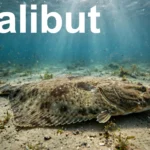







Halibut: The Giant Flatfish That Lies on the Ocean Floor
Halibut is the largest flatfish in the sea, and it is also one of the strangest. It is born looking like an ordinary fish, symmetrical, with an eye on each side of its head. Then, as it grows, its body flattens, one eye migrates across its head to join the other, and it settles onto the sea floor to live lying flat, eyed side up and camouflaged.
There are two kinds that matter: the Atlantic and the Pacific. Both live in cold northern waters, but their fortunes have gone in different directions: the Atlantic has been listed as Endangered since 1996, and the Pacific is listed as Least Concern.
What Halibut Is — The Biggest Flatfish
The Atlantic halibut, Hippoglossus hippoglossus, is the largest flatfish in the world, with the most massive individuals reaching about 4.7 metres and 320 kilograms, according to Britannica. The Pacific halibut, Hippoglossus stenolepis, is generally smaller, though its largest individuals come near 2.7 metres and 363 kilograms.
Those figures are worth stating as ranges rather than as records. Published claims about record weights disagree, so no single world-record weight is stated here.
The fish lives in cold northern waters: the North Atlantic for the Atlantic kind, and the North Pacific for the Pacific kind. It is a bottom fish, built for life on the sea floor.
Born Normal, Then One Eye Moves — The Metamorphosis
A halibut does not start life flat. It hatches as a symmetrical fish, with one eye on each side of its head, swimming upright like any ordinary fish. Then, as it grows, its body begins to flatten from side to side, and one eye migrates across the head to join the other on the same side.
The change is complete: the fish ends up with both eyes on one side of its head, and that side faces up. The other side, the blind side, faces down against the sea floor. It is one of the most thorough transformations in the sea, and it happens to every one of them.
The point of the change is the life that follows. A flat fish can lie on the sea floor and disappear against it, and a fish with both eyes on its upper side can watch the water above it. The metamorphosis is the whole design of the animal.
Atlantic vs Pacific
The table below sets out the two kinds side by side, so the comparison is easy to see.
| Kind | Size | Range | Status |
|---|---|---|---|
| Atlantic halibut | About 4.7 m / 320 kg at largest | North Atlantic | Endangered since 1996 |
| Pacific halibut | About 2.7 m / 363 kg at largest | North Pacific | Least Concern |
The Atlantic is the larger of the two in length, and it is the one in trouble: listed as Endangered by the IUCN since 1996, after being overfished. The Pacific is generally smaller in length, and it is listed as Least Concern.
Life on the Sea Floor — Camouflage and Hunting
A halibut lies on the sea floor, eyed side up, and its camouflage does the work. The upper side of the fish blends with the sand and gravel of the bottom, and the fish can lie still for long stretches, watching the water above it with both eyes. It is a hunter that waits, and its flatness is its cover.
When prey comes within reach, the fish strikes from below. It does not chase across open water; it rises from the bottom, takes what passes, and settles again.
The cold water matters too. Halibut live in the cold north, and their whole life — the flattening, the lying flat, the waiting — is built for the bottom of those seas.
Halibut on the Plate — Mild, Firm, Why It Costs What It Does
On the plate, halibut is mild and firm. The flesh is white, mild in flavour and firm in texture, and it holds together when cooked. It is a fish that takes seasoning well without being overwhelmed by it, and its firmness is what people remember: it slices cleanly and it does not fall apart.
That is the fish itself. The cost follows from the facts already stated. It is a very large fish, and the Atlantic, the larger of the two kinds, has been Endangered since 1996 after being overfished. A very large fish, from cold northern waters, with its Atlantic stocks under pressure: that combination is why halibut is treated as a premium fish, and why it costs what it does.
The Endangered Atlantic — What Happened
The Atlantic halibut has been listed as Endangered by the IUCN since 1996, and the reason is overfishing. It was fished hard, and its numbers fell far enough for the listing to follow. A fish that grows this large is vulnerable to heavy fishing: it takes time to reach its size, and removing the large fish removes the breeding stock with it.
The listing is a warning, not an ending. Endangered means the fish is at risk, and the risk came from how it was fished. The Pacific, by contrast, is listed as Least Concern, which shows that the outcome was not inevitable.
That is the story of the Atlantic halibut: the largest flatfish, brought low by overfishing and listed as Endangered since 1996. The fish itself has not changed. What changed was the pressure on it.
Frequently Asked Questions
What is halibut?
It is the largest flatfish in the sea, reaching about 4.7 metres and 320 kilograms at its largest, and the Pacific is generally smaller. Both lie flat on the sea floor with both eyes on one side.
How does a halibut end up with both eyes on one side?
It is born symmetrical, with one eye on each side of its head. As it grows, its body flattens and one eye migrates across its head to join the other, so both eyes end up on the upper side.
How big does halibut get?
The most massive Atlantic individuals reach about 4.7 metres and 320 kilograms, and the largest Pacific individuals come near 2.7 metres and 363 kilograms, according to Britannica. Published record claims disagree, so no single world-record weight is stated.
Where does halibut live?
In cold northern waters: the Atlantic kind in the North Atlantic, and the Pacific kind in the North Pacific. Both live on the sea floor, lying flat and camouflaged.
Why is Atlantic halibut Endangered?
It was overfished, and it has been listed as Endangered by the IUCN since 1996. The Pacific halibut is listed as Least Concern.
What does halibut taste like?
Its flesh is mild and firm, white in colour, and it holds together when cooked.
Conclusion
It is the largest flatfish in the sea, and the Atlantic is the largest of them all, reaching about 4.7 metres and 320 kilograms. It is born symmetrical and becomes flat, one eye migrating across its head until both eyes sit on the upper side, and it spends its life lying on the sea floor, eyed side up and camouflaged. The Pacific kind is generally smaller and listed as Least Concern, while the Atlantic has been Endangered since 1996 after being overfished. On the plate it is mild and firm, and its standing as a premium fish follows from its size and the pressure on its Atlantic stocks.
Related reading: Bolo Tie: The Cowboy Necktie Born From a Lost Hatband





One comment on “Halibut: The Giant Flatfish That Lies on the Ocean Floor”